

On chairs
A good chair asks you to sit properly.

I think about chairs more than is reasonable.
Not in a collector’s way or a designer’s way exactly, but in a bodily way. In the way you notice something once your weight has been badly held somewhere else.
A chair is a promise. It says: you can stop now.
But not all chairs mean that equally.
The history of the chair is also a history of power. For a long time, chairs were not for everyone. They were thrones, seats of authority, objects that lifted one body above others. To sit was to rule. To stand was to wait. Even now, traces of this remain in language: the chair of a department, the seat of government, taking a seat at the table.
Who gets to sit, and how comfortably, has always been political.
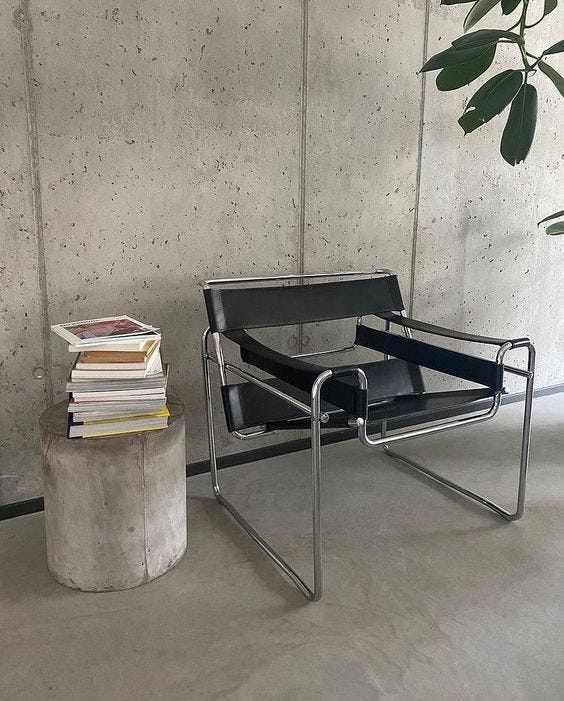
Modernist chairs tried to flatten this hierarchy. Or at least, that was part of the story they told. Marcel Breuer’s Wassily Chair, Mies van der Rohe’s Barcelona Chair, Le Corbusier’s LC series — all steel and leather and clean lines. Furniture for a new world. Rational, efficient, universal. Chairs for the modern citizen (except they weren’t universal at all).
Many modernist chairs were designed for an idealised body: male, able, average-sized, disciplined. They valued posture over rest, form over softness. They assumed a body that did not fidget, ache, or need to curl in on itself. Comfort was framed as something suspect - bourgeois, indulgent, unnecessary. A good chair, in this logic, trained you. It corrected you. It asked you to sit properly.
I find this fascinating, because it mirrors so much else about modern life. The way productivity has been prized over ease. The way discomfort is often reframed as virtue. The way bodies are expected to adapt to systems, rather than the other way around.
A chair can tell you what kind of body is welcome.

Think about waiting rooms. Plastic shells bolted together. Armrests placed not for comfort, but to prevent lying down. Think about public benches designed to deter lingering. Anti-homeless architecture disguised as neutral design. A refusal of rest, built into metal and concrete. These are political decisions, even when they pretend not to be.
I’m drawn, instead, to chairs that allow for inhabiting. Chairs that acknowledge that bodies are various and changeable. Chairs that let you sit sideways, tuck a leg under, lean an elbow, stay longer than planned. Chairs that don’t rush you.
I think of Alvar Aalto’s bentwood chairs, which feel almost apologetic in their curves. Or Charlotte Perriand’s work, which understood the domestic space as a site of care rather than display. Or the humble kitchen chair, worn smooth where hands have rested over years of conversations.
When a chair is comfortable, it grants permission. To pause. To stay. To take up space without explanation. That permission has not been distributed evenly. There is a reason why comfort is so often policed - in offices, in public spaces, in whose bodies are allowed to recline without judgement.
Even the phrase “don’t get too comfortable” carries a warning.
I notice how chairs shape behaviour. A hard-backed chair keeps you alert, slightly on edge. A deep armchair invites confession. A stool suggests impermanence. A pew aligns bodies in shared restraint. A throne isolates.
At home, the chairs I love most are not the most impressive ones. They are chosen for how they hold me at the end of the day, when thinking has gone quiet. A chair positioned close to the light. A chair that knows my weight. A chair that does not correct my posture, but accommodates my tiredness.
That a body does not need to earn softness. That a seat does not need to prove anything.
I don’t want chairs that train me. I want chairs that listen.

In a culture that keeps removing places to sit (literally and metaphorically) choosing comfort feels like a small act of resistance. To sit when you are told to stand. To rest when you are told to keep going. To design, choose, and value objects that support rather than discipline.
So yes, I think about chairs. About who they were made for. About who they exclude. About what they say when they offer you a place to linger.
And I keep coming back to this: a chair can either ask something of you, or give something back.
I know which kind I want to live with.